Newsletter Subscribe
Enter your email address below and subscribe to our newsletter

 ByJohn A
If you design steering linkages, wheel hubs or aircraft control systems, the fastening requirement often includes keeping each nut fixed at one exact position. Castle nuts meet that need by pairing a threaded connection with a physical lock, which suits assemblies where vibration and repeated movement form part of everyday service.
Specified correctly, castle nuts give engineers a locking method which is simple to fit, easy to inspect and dependable under constant motion. The right result depends on material, dimensions, hole alignment and careful manufacturing control. Keep on reading to know more about how each factor supports secure fastening in high-vibration assemblies.
Where Rotational Locking Matters: A positive lock is most useful where a joint carries low preload or moves in service, such as wheel bearing adjustment, steering linkages and control rods. In these assemblies, a physical lock keeps the nut at its set position through constant movement. So, castle nuts are often specified where the nut position itself is part of the design.
How Vibration Acts on Threaded Joints: Repeated side-to-side movement at a joint can gradually rotate a nut which relies on friction alone, so high-vibration assemblies benefit from a physical lock. Vibration near an assembly’s resonant frequency amplifies this movement. In everyday maintenance practice, technicians often find that a split pin in place gives quick visual confirmation that the nut has stayed in position.
See also: What Gets Better With Time and What Reveals Itself Immediately
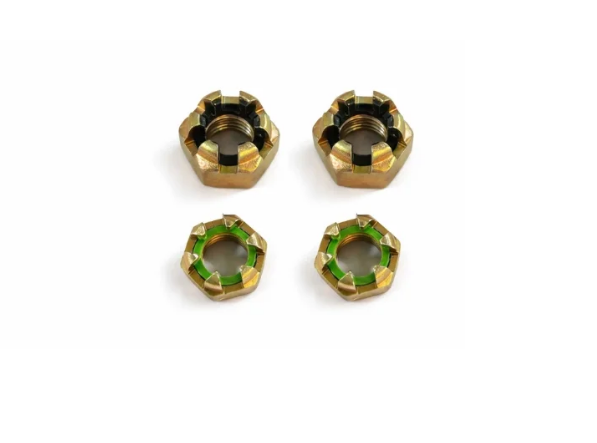
How the Castellated Design Works: A castle nut has a slotted crown above its hexagon, and a split pin passes through one slot and a cross-drilled hole in the bolt. Once the pin legs are bent back, the pin holds the nut at that position while the threads carry the clamping load. Slotted nuts follow the same idea with slots cut into the hexagon.
Split Pin Fit and Positioning: A split pin should fill the slot and bolt hole closely, and ISO 1234 sets the standard dimensions for metric split pins. A close fit keeps the pin steady under vibration, and a new pin is usually fitted each time the joint is reassembled. Pin material is chosen to suit the nut and the working environment.
Material and Dimensional Choices: Nut material is usually matched to the strength class of the bolt and the conditions around the joint. Carbon steel nuts in matching property classes suit general machinery, while stainless steel grades suit damp or washdown settings. Thread pitch, overall height, slot width and slot depth all need to suit the bolt and split pin.
Bolt-Hole Alignment and Installation: The bolt’s cross hole has to line up with a slot once the nut reaches its specified tightness, so hole position and grip length are set together. A stated torque range lets the installer turn the nut forward to the next slot. If the hole sits between slots, then a washer of different thickness can bring them into line.
Prevailing Torque Nuts and Adhesives: Prevailing torque nuts, such as nylon insert and all-metal types, grip the thread through friction and install quickly with no drilled bolt. Thread-locking adhesives also suit many general assemblies. Nylon inserts work within set temperature ranges, and adhesives need clean threads and curing time, so each option fits particular service conditions.
Where a Positive Lock Suits Best: Castle nuts suit joints where the nut must stay at a precise position and where visual inspection matters. They need a drilled bolt and give set positions rather than an exact torque value. If instead the joint needs fast assembly and high clamping force, then a prevailing torque nut is probably the more practical choice.
Consistent Slots, Threads and Heat Treatment: Controlled manufacturing keeps slot width, slot position and thread form consistent from nut to nut, which lets every split pin fit as designed. Heat treatment and hardness checks confirm that each batch suits its property class. For aerospace and automotive work, material traceability links each batch to its raw material records and test results.
Early Specification and Long-Term Value: The best time to choose a pinned nut arrangement is while bolt and hole positions are being designed. If the decision waits until shafts and studs are made, then drilling positions and grip lengths are largely fixed and the choices narrow. Well-made nuts matched early probably give years of steady service with simple visual checks.
Details to Confirm before Ordering: A complete order states the thread, dimensions, material and finish which affect how the nut locks and holds. Once these points are agreed, castle nuts arrive ready to fit and match the bolt and split pin already specified. The points below cover what engineers and buyers most often check on the drawing.
A correctly specified castle nut gives your high-vibration assemblies a visible, mechanical lock which holds the nut exactly where it was set. Settling the locking method now is simpler than redrilling finished bolts later. Get in touch with a precision fastener manufacturer today to discuss the thread, material and slot details your next assembly needs.